
Disclosure: Home Barista Guide uses affiliate links. If you buy through one of our links, we may earn a small commission at no extra cost to you. This does not affect how products are assessed.
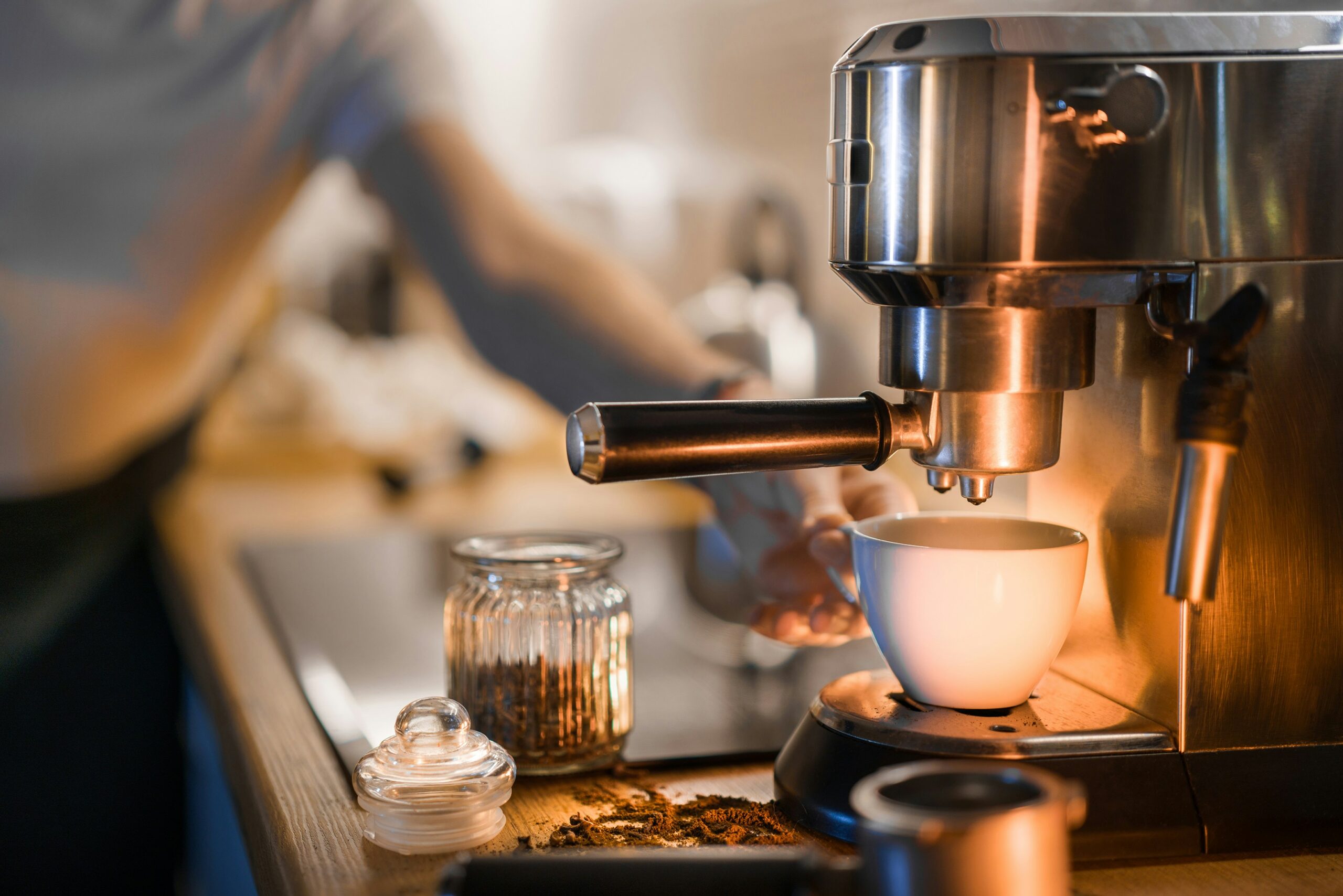
The De’Longhi Dedica Duo is a compact manual espresso machine for people who want to grind, tamp and steam their own coffee without giving up a large section of worktop. Its strongest case is versatility in a 15cm-wide body: it prepares hot espresso, double espresso and a quick cold-extraction drink, while the manual steam wand gives you direct control over milk texture. The trade-off is that it remains a hands-on setup and needs a suitable grinder to make the most of fresh beans.
Check the model before buying. This review covers the current UK stainless-steel Dedica Duo, EC890.M. Other colour versions use different suffixes, while older Dedica machines have different controls, steam wands and drink options.
Beginners and small-kitchen users who want a hands-on espresso and milk routine without buying a large machine.
You want one-touch drinks, an integrated grinder or the greater extraction control of an enthusiast-focused espresso setup.
A very narrow footprint combined with hot espresso, quick cold extraction and a capable manual steam wand.
The supplied pressurised baskets are forgiving, but limit how far you can refine espresso compared with a more advanced setup.
Our rating: 8/10
A strong compact first espresso machine
This is an editorial score based on the current UK specification, pricing, buyer fit and available independent and verified-owner evidence. Home Barista Guide has not personally lab-tested this machine.
The Dedica Duo makes the most sense for someone who wants to participate in the process without starting with a bulky or highly technical machine. You still grind or measure the coffee, fill and lock in the portafilter, start the drink and steam milk manually, but the pressurised filter baskets and preset buttons make the early learning curve more forgiving.
Its cold-extraction preset is a genuine point of difference, and the upgraded steam wand makes it more flexible than basic entry-level machines with an aerating sleeve. The limits are equally important: there is no grinder, the supplied baskets prioritise ease over maximum espresso control, and the compact chassis cannot hide all the noise and mess of a manual pump machine.
Current published specifications
| Exact UK model | De’Longhi Dedica Duo EC890.M, stainless-steel finish |
|---|---|
| Machine type | Manual pump espresso machine; separate grinder required for whole beans |
| Preset drinks | Espresso, double espresso and cold brew |
| Coffee inputs | Ground coffee or compatible ESE paper pods; it does not use capsules |
| Supplied filters | Filters for ground coffee and compatible ESE paper pods; exact box contents vary between current retailer listings |
| Heating system | Thermoblock |
| Milk system | Manual cool-touch My LatteArt steam wand |
| Water tank | 1.1 litres, removable |
| Two-cup capability | Yes, using the double filter and twin-spout portafilter |
| Maximum cup height | Up to 12cm with the adjustable drip-tray arrangement |
| Pump rating | 15 bar — this is the pump specification, not proof of the pressure applied at the coffee puck |
| Power and voltage | 1450W; 220–240V UK model |
| Dimensions | 149 × 330 × 305mm (W × D × H) |
| Published weight | 4.7kg from De’Longhi |
| Controls | Top-mounted touch controls with coloured icons and status LEDs |
| Manufacturer guarantee | Two years through current major UK retail listings |
| Typical current price | RRP £279.99; live prices and colour promotions can vary |
ESE pods are not capsules
The supplied ESE filter is for flat, paper-wrapped Easy Serving Espresso pods. The machine does not accept Nespresso, Dolce Gusto or proprietary De’Longhi capsules. Freshly ground coffee remains the more flexible route, but ESE pods are useful when convenience matters.
Espresso quality and control
The Dedica Duo uses a traditional portafilter workflow: add ground coffee, tamp it, lock the handle into the group and start either the single or double espresso preset. The machine controls the water delivery, but grind size, dose, distribution and tamping still influence the result. That makes it more involved than a capsule or bean-to-cup machine, while remaining less intimidating than a fully manual enthusiast setup.
The supplied baskets are pressurised, also described as double-wall baskets. They are designed to create usable resistance even when the grind is not perfectly dialled in, which can help beginners and people using pre-ground coffee. The trade-off is a lower quality ceiling: they give you less direct feedback and less control than a well-matched grinder and non-pressurised basket.
Independent hands-on reviews of this model generally found the hot espresso repeatable once the coffee and dose were set sensibly, but they also disagreed on how much refinement the machine offers for the price. That is a fair summary of its place in the market. It is a practical first manual machine rather than a long-term platform for someone who wants to experiment deeply with puck preparation, pressure and extraction.
About the 15-bar claim
The advertised number describes the pump’s maximum capability. It should not be used as evidence that the Dedica Duo extracts at 15 bar or that it automatically produces better espresso than a machine with a lower pump rating.
Quick cold extraction
The cold-brew button bypasses the normal hot Thermoblock route and uses De’Longhi’s Cold Extraction process to prepare a cooler coffee in less than five minutes. This is much quicker than traditional immersion cold brew, which is normally steeped for many hours, and it avoids simply pouring a hot espresso directly over ice.
The result should still be understood as the machine’s own quick cold-extraction recipe rather than a perfect substitute for every style of bottled or immersion cold brew. Its value depends on your routine: iced-coffee drinkers gain a useful extra mode, while someone who only makes hot espresso may find a simpler Dedica model better value.
Milk drinks: manual control with a learning curve
The manual My LatteArt wand is a substantial part of the Duo’s buying case. Unlike a basic panarello sleeve that automatically pulls in a large amount of air, this wand asks you to position the steam tip and control how much air is introduced. With practice, that gives you a better chance of producing smooth milk for flat whites, lattes and cappuccinos.
The cool-touch design makes the outer wand easier to handle and wipe after use, but it does not make milk steaming automatic. You still need a cold jug, the right milk level and time to learn the difference between adding air and rolling the milk. Independent reviewers found the wand usable but not universally effortless, with steam noise and technique forming part of the learning curve.
This is a good fit for someone who wants to learn milk texture. It is a poorer fit for someone who expects a latte at one touch. In that case, a bean-to-cup machine with an automatic carafe or a separate electric frother will suit the intended routine better.
Daily use, grinder cost and kitchen fit
The Dedica Duo has no built-in grinder. You can start with supermarket pre-ground coffee or ESE pods, but freshly ground beans give you more control over flavour and flow. For that, you need a burr grinder that can adjust finely enough for espresso and make repeatable small changes.
This changes the real purchase price. A capable grinder, beans and possibly a small set of scales can make the complete setup cost substantially more than the machine alone. Avoid choosing a general filter-coffee grinder simply because it uses burrs; the adjustment range and repeatability need to suit espresso. Our grinder guide can help you compare suitable options.
The machine’s 15cm width is the headline dimension, and it genuinely helps on a crowded worktop. Its depth is still about 33cm, so allow room behind and in front for the removable water tank, portafilter handle and drip tray. The top-mounted buttons also need some clearance if the machine sits beneath a low cupboard.
The expanded drip tray accommodates cups and glasses up to about 12cm tall, and the wider tray gives two espresso cups more usable space than narrower older Dedica layouts. The 1.1-litre tank is reasonable for a compact manual machine, but steaming, rinsing and preheating consume water as well as the drinks themselves.
The coloured touch icons keep the front clean, though status lights are not always self-explanatory until you learn their patterns. There is no three-way solenoid to dry the coffee puck immediately after brewing, so some dripping and wetter used grounds can be normal. These are workflow considerations rather than signs that the machine is necessarily faulty.
Cleaning, consumables and long-term ownership
Daily care is straightforward but cannot be skipped. Knock out the used coffee, rinse the filter and portafilter, empty the drip tray when needed, and purge and wipe the steam wand immediately after milk use. Dried milk is much harder to remove and can block the steam openings.
The tank and drip tray are removable, and the machine includes a descaling programme. The correct interval depends on water hardness and how often the machine is used, so follow the hardness setting and descale promptly rather than applying a generic monthly schedule.
De’Longhi maintains a dedicated UK support page for the exact model with safety information, a quick-start guide, product documentation and access to authorised service centres. Descaler and general espresso-machine care products are also readily available. That gives the Duo a clearer ownership route than an obscure compact machine with no established parts or service network.
- After each coffee: remove the used grounds and rinse the filter and portafilter.
- After steaming: purge and wipe the wand before milk dries onto it.
- Regularly: wash the drip tray, water tank, jug and removable accessories.
- When prompted: complete the descaling programme using a compatible descaler.
Which Dedica should you buy?
Dedica Duo
Choose it for: a narrow manual machine with hot espresso, quick cold extraction and a proper manual steam wand.
Trade-off: you pay more for the added cold-drink mode and updated workflow, while still needing a separate grinder for fresh beans.
A lower-priced Dedica
Choose it for: straightforward hot espresso and occasional milk drinks when cold extraction is unlikely to be used.
Trade-off: the interface, steam wand and included features vary by exact model, so compare the current specification rather than assuming every Dedica is interchangeable.
The Duo is not automatically better merely because it is the newer Dedica. Its extra value is concentrated in the cold-extraction mode, updated interface, wider drip tray and My LatteArt wand. Those features need to match your routine. Someone who mainly wants a straightforward morning espresso may be better served by a cheaper machine and a stronger grinder.
What about a bean-to-cup machine?
A bean-to-cup machine is the stronger alternative when convenience matters more than learning espresso technique. It grinds and doses automatically, but gives you less direct involvement and generally occupies more worktop space. The Dedica Duo suits buyers who actively want the manual process rather than simply wanting coffee from fresh beans.
Pros and good to know
Pros
- Very narrow 15cm body
- Dedicated hot espresso and quick cold-extraction presets
- Manual cool-touch steam wand offers real milk-texture control
- Pressurised filters are approachable for beginners
- Ground coffee and ESE pod flexibility
- Metal tamper and stainless-steel milk jug included in current UK bundles
Good to know
- No built-in grinder, so fresh-bean setup costs more
- Supplied pressurised baskets limit the enthusiast upgrade path
- Milk steaming requires practice
- Status-light patterns can take time to learn
- Pump and steam operation are clearly audible
- Cold extraction is the main reason to pay more than for a simpler Dedica
Verdict: is the De’Longhi Dedica Duo worth buying?
Yes, when its compact size and cold-drink flexibility solve real problems for you. The Dedica Duo is an approachable first manual espresso machine that still lets you learn the fundamentals of grinding, dosing, tamping and milk texture. Its narrow body is genuinely useful, and the combination of hot espresso, quick cold extraction and a proper manual wand is unusual in this footprint.
The value is less convincing if you will never use cold extraction or do not want a hands-on routine. The supplied pressurised baskets make early results easier, but they also mean this is not the strongest platform for someone already planning an enthusiast espresso setup. Budget for a suitable grinder and choose it for convenience within a manual workflow—not because the machine alone guarantees better coffee.
Frequently asked questions
Does the De’Longhi Dedica Duo use capsules?
No. It uses ground coffee and compatible ESE paper pods. ESE pods are flat, individually wrapped portions of compressed ground coffee; they are not Nespresso, Dolce Gusto or De’Longhi capsules.
Do I need a grinder for the Dedica Duo?
You need an espresso-capable grinder if you want to use whole beans and adjust the grind yourself. The machine can also use suitable pre-ground espresso coffee or ESE pods, so a grinder is not essential for initial operation.
Can it make two espressos at once?
Yes. Current UK bundles include a double-cup filter, and the portafilter has twin outlets for placing two espresso cups beneath it. It does not prepare two complete milk drinks automatically.
Is its cold brew the same as overnight cold brew?
No. The machine uses a dedicated quick cold-extraction process that takes less than five minutes. Traditional immersion cold brew normally steeps for many hours, so the methods and final flavour are not identical.
Does it include single-wall filter baskets?
Independent exact-model reviews identify the supplied coffee baskets as pressurised or double-wall filters. That makes them more forgiving, but buyers specifically seeking a non-pressurised setup should not assume one is included.
How quickly does the Dedica Duo heat up?
It uses a Thermoblock heating system, but De’Longhi’s current UK page does not publish a precise heat-up time for this exact model. Wait for the relevant drink icon to show that the machine is ready rather than relying on a generic Dedica timing.
How often does it need descaling?
The interval depends on water hardness and use. Set the machine up for your local water and descale when prompted rather than following a fixed monthly or cup-count schedule.
Guidance based on current De’Longhi UK specifications and support material, exact-model retailer information, independent testing and hands-on reviews, and verified-owner feedback as of July 2026. Prices, bundles and product configurations can change.